Anthony Thomas
Let us start with the bit most problem lists skip.
The VP9SK is one of the most reliable small pistols you can buy. One reviewer has run more than 3,000 rounds through his with no malfunction at all. Another put more than 1,000 rounds through one with no cleaning and still got no malfunctions.
So HK VP9SK problems are not a reliability horror story. They are a short, specific list. A stiff new gun that can sulk on light ammo, a slide stop that sits right where your thumb wants to be, a grip that is too short with the flush magazine, and a pistol that is thicker than the word subcompact leads you to expect.
Name those four, plus two smaller ones below, and you have pretty much the whole ownership experience. Here is each one, what causes it, and what to do about it.
Quick verdict: Buy the VP9SK if you want a small gun that shoots like a bigger one. The trigger is excellent, the grip adjusts to your hand in a way most small pistols cannot match, and the long tests are about as clean as long tests get.
Just budget for the right magazines, break it in on proper ammo, and accept that it is a chunky little thing. If thin is everything to you, buy something thinner and accept that it will be harder to shoot well.
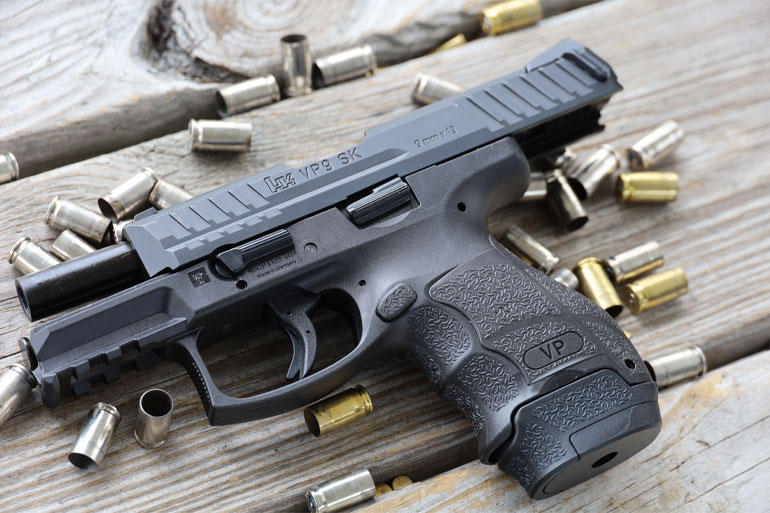
Table of Contents
HK VP9SK Specs
Caliber: 9mm Luger. Action: striker fired.
Barrel: 3.39 inch, cold hammer forged, polygonal rifling. Overall length: 6.61 inch.
Height: 4.57 inch. Width: 1.31 inch. Weight: 23.07 oz with an empty magazine.
Capacity: 10 plus 1 flush, 12, 13, 15, 17 and 20 round VP9 family magazines also fit. Trigger: about 5.1 lb measured, clean break, short positive reset.
Sights: 3 dot luminous, night sight versions offered. Controls: ambidextrous slide stop, paddle magazine release, or push button on the VP9SK-B.
Grip: interchangeable backstraps and side panels, finger grooves. Accessory rail: short Picatinny rail, compact lights only.
Optics: no cut on standard guns, optics ready OR versions sold separately.
HK VP9SK Problems at a Glance
Break in failures to feed, eject, or return to battery. This is common on new guns with light ammo, and medium seriousness while it lasts.
Yes, you can fix it yourself, with ammo and lube. It costs one or two boxes of 124 grain ammo.
Slide will not lock back on the last round. This is very common, and low to medium seriousness.
You can usually fix it yourself, because it is your thumb. It is free, or a spring under warranty.
Pinky hangs off the flush magazine. This affects every gun with the flush mag, and is low seriousness.
Yes, you can fix it. It costs one extended magazine or floor plate.
Thick and heavy for a subcompact. This affects every gun, by design, and is low seriousness.
No, you cannot fix it, because it is a buying decision. A proper belt and holster help.
Paddle release learning curve and magazine confusion. This is common for new owners, and low seriousness.
Yes, you can fix it, with training and the right mags. Training is free, spare mags cost money.
Short rail limits your choice of weapon light. This affects every gun, by design, and is low seriousness.
You can partly fix it. It costs one compact light that actually fits.
1. A New VP9SK Can Fail to Feed, Fail to Eject, and Refuse to Return to Battery
This is the complaint that fills the first forum thread most new owners write, and it has a boring explanation. The gun is new, the springs are stiff, and the ammo is soft.
The clearest test we found comes from a law enforcement firearms instructor who tested a VP9SK LE. Early on, the pistol malfunctioned at least once with every magazine. The main faults were failures to feed into the chamber and failures to eject, the classic signs of a slide that is not cycling fully.
It did it with all three magazines, so the magazines were not the story. He worked through the suspects honestly. A wrist that was not locked. Weak ammo. Light 115 grain bullets.
Then the pattern broke. At about 250 rounds, on 124 grain loads, the malfunctions stopped. Gold Dot 124 grain plus P ran clean too. The gun finished the day at 470 rounds, went home for a proper clean and lube, and a few days later his son shot a match with it on Winchester NATO 124 grain.
No malfunctions at all, and the kid tied for first.
His closing advice is worth quoting in spirit if not word for word. Be ready to break this pistol in on 124 grain or plus P ammunition. A separate problem roundup reports the matching symptom, about three failures to return to battery in 200 rounds on 115 grain, with the shooter nudging the slide home with a thumb each time.
How to break in a VP9SK without losing your mind
- Clean it before you shoot it. New guns ship in preservative oil, not working lube. Strip it off, oil the contact points properly, and start from a known state. One reviewer who does exactly this reports more than 1,000 trouble free rounds.
- Break it in on 124 grain ammo. Run your first few hundred rounds on quality 124 grain, ideally NATO spec, and save the soft 115 grain range ammo for later. This is the single change that ended the stoppages in the test above.
- Hold it like you mean it. A short slide with stiff springs punishes a loose grip. Lock your wrist, get high on the grip, and let the gun cycle.
- Swap magazines before you blame the gun. If one magazine misbehaves and the others do not, you have found your problem, and it is a cheap one.
- Know when break in stops being the answer. If the gun still fails to feed or return to battery past a few hundred rounds on good 124 grain ammo, or it does it with your carry load, stop excusing it and contact HK. That is no longer break in. That is a warranty conversation.
2. The Slide Will Not Lock Back on the Last Round
Sound familiar? It should. This is the same story as the full size VP9, made a touch worse here because the ambidextrous slide stop gives both of your thumbs a lever to sit on.
Start with the most honest review line in this whole article. A magazine reviewer tested a VP9SK and reported reliability that was stellar, with exactly one failure. The slide did not lock open after the last shot, and he says flatly that it was solely his own fault for depressing the slide stop.
No excuses, his words in effect, on a pistol with grips this large.
The instructor in the break in test above watched the left handed version of the same thing. His son had never shot a pistol with an ambidextrous slide lock before, so his thumbs kept ending up near the right side lever. Left handed, right handed, it does not matter.
There is a lever on both sides of this gun, and one of your thumbs probably wants to live on it.
There are two other causes, and they are real parts problems, so do not skip them. Problem roundups for this pistol describe guns that stopped locking back after a few hundred rounds, where swapping the slide lock itself did not help, and HK customer service traced it to the slide lock spring.
A new spring fixed it. The same roundups describe one specific 15 round magazine that would not lock the slide open at all, while the 10 and 13 round magazines worked perfectly.
How to tell which one you have
- Run the one round test. Load one round, keep both thumbs deliberately clear of the levers, and fire. If the slide locks back, the gun works and your grip is the fault.
- Hand it to someone else. If it locks back for them, adjust your thumb placement and move on. This test costs nothing and settles most arguments.
- Test magazine by magazine. Mark your magazines with a paint pen. If the failure follows one magazine, clean it and check its follower and spring, and ask HK about a replacement if it keeps failing.
- Only then suspect the spring. If every magazine fails, for every shooter, with thumbs clear, contact HK about the slide lock spring. That is a parts fix, and it is theirs to sort out.
3. Your Pinky Hangs Off the Grip With the Flush Magazine
The VP9SK ships its smallness honestly. With the flush 10 round magazine fitted, most adult hands get two fingers on the grip and a pinky swinging in the breeze. That is not a cosmetic complaint.
On a small gun, the pinky does real work keeping the muzzle down.
Reviewers keep landing on the same fix. The NRA review found shooting with the finger extension magazine significantly more comfortable than the flush version, where the reviewer’s pinky had nowhere to go. Gun University goes further and strongly recommends the extended floor plate.
It lets your pinky wrap around the grip, gives you much more control, and the reviewer says the gun was not nearly as controllable without it. He would grade the ergonomics a step lower on the flush magazine alone.
The good news is that HK gives you options most makers charge extra for. Extended floor plate 10 round magazines, a 12 round magazine that adds grip length without much bulk, and full size VP9 magazines all fit this gun.
Setting up the grip properly
- Make the extension magazine your default. Carry the extended floor plate or 12 round magazine as your main, and keep the flush magazine for the days when concealment matters more than control.
- Use the parts in the box. The gun comes with extra backstraps and side panels. Try the mixes at the range, not at the counter. A panel change can make the short grip feel a size bigger.
- Judge the gun in its best setup. Almost nobody carries this pistol at its worst. Shoot it with a full grip before you decide it kicks too much or points badly, because for most hands, that is a magazine problem wearing a gun problem costume.
4. It Is Thick and Heavy for a Gun Called a Subcompact
Let us put the numbers where you can see them. The VP9SK is 1.31 inches wide and weighs 23.07 ounces empty. A Sig P365XL is about 1.1 inches wide and about 20.7 ounces. That gap does not sound like much on paper.
On your belt, at hour ten, you will know about it.
A Firearms News reviewer made the sharpest version of the point. The length and height are fine, he says. It is the thickness that pushes this pistol out of the subcompact class in spirit, and a thick gun is simply harder to conceal than the name suggests.
Gun University agrees in softer language. The SK is thicker than a P365XL or a Glock 43X, it is not the smallest option out there, and appendix carry is less comfortable than with thinner pistols. Guns.com calls it a tad hefty and large by modern micro 9mm standards, and notes the standard 10 plus 1 capacity is small for a gun this size now.
Here is the trade, stated fairly, because that same reviewer at Gun University still picked the VP9SK over his P365XL as his carry gun. The bulk is exactly why it shoots so well. Weight soaks up recoil, a wide grip spreads it out, and the gun behaves like the full size VP9 shrunk, not like a micro gun stretched.
You are not buying the easiest gun to hide. You are buying the easiest small gun to shoot well.
If you carry one anyway, do this
- Use a real gun belt. A thick 23 ounce pistol on a soft fashion belt sags, prints, and feels heavier than it is. This is the cheapest comfort upgrade on this page.
- Try both carry positions. Plenty of owners who find appendix carry crowded with this gun find strong side carry perfectly comfortable, thanks to that supportive holster and belt.
- Be honest before you buy. If your whole goal is the thinnest, lightest setup for summer clothes, a micro 9mm serves that goal better, and no holster fixes physics.
5. The Paddle Magazine Release Takes Learning, and the Magazine Options Take Reading
Two smaller annoyances live in the same neighbourhood, so they share a section.
First, the release. Standard VP9SK pistols use HK’s paddle release, a pair of small levers at the back of the trigger guard. It is ambidextrous, it is fast once you learn it, and if you have spent years thumbing a button, your first week with it will feel like learning to write with your other hand.
The NRA reviewer is balanced about it. It took him time to get used to, it never actually failed him, and he calls it a training concern rather than a flaw, while admitting he would still prefer a button to match his other pistols.
HK read that room years ago. The VP9SK-B variant exists for exactly this reason, with a traditional push button release. Neither gun converts to the other system. So the real fix happens at the shop counter, not at home.
Second, the magazines. This gun takes its own 10 and 12 round magazines, larger SK magazines, and full size VP9 magazines up to 20 rounds. That flexibility is great. It also means extended magazines can wobble or pinch without the right grip sleeve, spare magazines were genuinely hard to find at launch, and as you saw in section two, one faulty magazine can imitate a broken gun.
Getting both sorted
- Choose your release before you pay. Paddle or button, VP9SK or VP9SK-B. Handle both if you can. This decision is free on day one and expensive on day thirty.
- Train the paddle properly if you buy it. Most shooters end up using a trigger finger or middle finger on the paddle, and after a few hundred reps it stops feeling foreign and starts feeling fast.
- Use the right sleeve on extended magazines. If you run 15 or 17 round VP9 magazines in the SK, fit the correct grip sleeve so the magazine sits solid and your hand does not get pinched on a reload.
- Number your magazines. A small paint mark today is what lets you spot a problem magazine in minutes later, instead of blaming the pistol.
6. The Rail Is So Short That Most Weapon Lights Will Not Fit

This is the only real downfall one long term reviewer found in more than 1,000 rounds, and it is a physical fact of the gun. A 3.39 inch barrel means a short dust cover, and a short dust cover means very little rail.
His report is specific. The Picatinny rail on the frame is extremely small, and at the time of his test the only light he found that would fit it properly was the Streamlight TLR-7. He rates that light highly, so this is not a disaster.
It is a short menu with one good dish on it. The problem only bites if you already own a full size light, or your heart is set on a model that needs two rail slots to clamp onto.
Buying a light for a VP9SK
- Check the fit list, not the marketing photos. Only order a light if the maker names the VP9SK, or the short rail VP and P30 family, as a fit.
- Start with the proven fit. The TLR-7 family is the light the long term test above actually ran on this gun, and compact lights in that class are what this rail was sized for.
- Test it under recoil. A light clamped onto a single slot has to prove it stays put. Fire a few magazines with it fitted before you trust it for carry.
- Decide if it changes the gun choice. If a specific full size light is non negotiable for you, that is a fair reason to buy the larger VP9 instead. Better to learn that from a paragraph than from a parcel you have to return.
HK VP9SK Problems That Are Not Really Faults
The trigger. If you have read complaints about VP9 triggers elsewhere, put them aside for this gun. One tester called it the best striker fired trigger he has felt. Guns.com measured a crisp 4.8 lb break with a fast, positive, audible reset.
The 3,000 round reviewer still runs the factory trigger and has never felt the need to change it. Preference is fine. A pattern of faults, this is not.
The accuracy. Handguns Magazine grouped five shots at or under two inches at 25 yards. The instructor in the break in test called it radically accurate and one of the most accurate out of the box pistols he has seen.
If your VP9SK groups badly, look at the short grip setup in section three and at your own trigger work before you look at the barrel.
The sights only glow after light. True. The standard 3 dot sights are luminous, not tritium, so they need charging with light and fade in the dark. Night sight versions exist and cost more. Annoying if you assumed otherwise, so check at the counter, but it is a spec to read rather than a defect to fix.
There is no red dot cut. Also true on standard guns, and also a buying check. Optics ready versions are sold under their own model names now, with OR in the description. If you want a dot, buy the OR gun.
Do not buy the standard gun and budget for slide milling unless you have priced that job and still want it.
That short list covers most of what owners actually search for, and notice what is not on it. No cracking frames, no dead triggers, no magazines falling out. The faults are fit, feel, and first impressions.
HK VP9SK Maintenance Checklist
- Clean off the factory preservative and lube the gun before the first range trip
- Break it in on 124 grain ammo, and keep notes on which loads your gun likes
- Mark every magazine with a number, so a fault that follows one magazine is easy to spot
- Run the one round lock back test whenever the slide stops locking open, before you order parts
- Check that your weapon light is still tight after every range session
- Try every backstrap and side panel combination at least once at the range
- Keep one known good magazine aside as your test magazine for any new stoppage
Is the HK VP9SK Still Worth Buying?
Yes, for the right buyer, and the long tests make this an easy call.
A pistol that runs 3,000 rounds for one reviewer and 1,000 uncleaned rounds for another, groups under two inches at 25 yards, and gives you a trigger and grip most small guns cannot match is not a gamble. The price of admission is written all over this page.
You break it in on decent ammo. You give your pinky a proper magazine. You learn a paddle release, or you buy the button model. And you carry a gun that is wider than the micro 9mm crowd and shoots better than all of them.
Buy it if you shoot a full size VP9 already, if small guns usually feel too small in your hands, or if you would rather have a carry gun that is easy to shoot well and a bit harder to hide. Think twice if you want the thinnest possible summer carry gun, if you will only ever feed it the cheapest 115 grain ammo you can find, or if you need a specific large weapon light fitted.
Those buyers exist too, and a slimmer micro 9mm will make them happier.
Conclusion
HK VP9SK problems are real, but they are front loaded. Almost all of them live in the first few weeks of ownership.
The new gun wants proper ammo and real lube while it breaks in. Your thumb wants to sit on the slide stop until you train it off. The flush magazine wants replacing with one your pinky can hold. After that, what is left is a set of facts to accept rather than faults to fix.
It is thick. It is not light. Its rail fits compact lights only. Accept those, and the pistol underneath them is the one the long tests describe. Accurate, soft shooting for its size, and dependable for thousands of rounds.
Do the cheap fixes first, in the order on this page, and there is a good chance your VP9SK becomes what it became for the reviewer who replaced his thinner carry gun with one. The small pistol you actually shoot best.
Sources used for this article: Handguns Magazine VP9SK review, Harbour Arms VP9SK LE test, Gun University VP9SK review and 3,000 round update, Guns.com VP9SK range test, Shooting Illustrated VP9SK review, Firearms News VP9SK-B review, Athlon Outdoors VP9SK tests, GTI Training VP9SK review, GunsAdvisor and GunAnalyst VP9SK problem roundups, and HK dealer specification listings. Last updated: October 2026.