Anthony Thomas
The Vortex Venom built its reputation in two places at once.
On pistols, it became the affordable dot that competition shooters actually trusted. On turkey shotguns, it became something close to standard equipment, a big window, a clear dot, and a price that did not sting.
Underneath both reputations sits the same safety net: the Vortex VIP warranty, which is about as close to unconditional as warranties get.
Vortex Venom problems, then, are not about a bad sight. They are about a sight with a few well known habits that catch owners out in predictable ways.
The elevation adjustment runs out on shotgun mounts more often than it should. The battery cap cross threads if you rush it.
The clicks feel vague. And the battery numbers on the box assume you will not leave it on maximum brightness, which owners cheerfully do.
We will take them in order, starting with the elevation section, because that is the one a lot of you searched for specifically.
Quick verdict: The Venom is a proven, likeable sight, and most of its problems are setup problems wearing a disguise. Centre the adjustments before you zero, start the battery cap by hand, and run the automatic brightness mode, and you will avoid four of the six issues below entirely.
Anything left over after that, a flicker that will not die or an adjustment that will not travel, is what the VIP warranty exists for, and Vortex is famously easy to deal with.
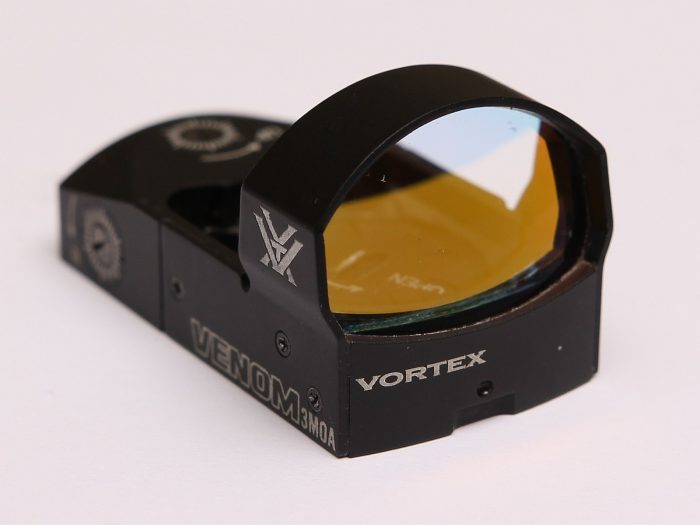
Table of Contents
Vortex Venom Specs
Reticle: 3 MOA or 6 MOA red dot. Magnification: 1x.
Housing: machined aluminium, hard anodized. Lens: fully multi coated glass, ArmorTek exterior coating.
Battery: one CR1632, top loaded. Battery life: 150 hours on highest setting, thousands of hours on low settings.
Illumination: 10 manual levels plus automatic brightness mode. Auto shutoff: about 14 hours in automatic mode.
Footprint: Docter and Noblex pattern. Does not fit: RMR, RMSc and RMRcc plates and cuts.
Adjustment: 1 MOA per click, flush screws. Adjustment travel: 130 MOA elevation, 100 MOA windage.
Window size: about 26.4 mm wide by 16 mm tall. Size: 1.9 inches long, about 1.1 inches wide.
Weight: 1.1 oz, about 1.6 oz mounted. In the box: Picatinny mount, rubber cover, adjustment tool, lens cloth.
Warranty: Vortex VIP, unconditional lifetime.
Vortex Venom Problems at a Glance
Elevation runs out before zero. This is the most searched problem, and medium seriousness.
You can usually fix it yourself. It costs a shim plate, or free setup time.
Battery cap cross threads. This is a very common complaint, and medium seriousness.
You can prevent it, but not repair it. It is free to prevent, warranty if stripped.
Flickering dot or no dot. This is common, and medium to high seriousness.
You can usually fix it yourself. It costs a battery and a clean cap seat.
Short battery life at high settings. This is a common surprise, and low seriousness.
Yes, you can fix it yourself. It costs a battery a year and better habits.
Vague, unresponsive adjustment clicks. This is a common complaint, and low seriousness.
You work around it. It is free.
Dot blooms at high brightness. This is common in bright sun, and low seriousness.
Yes, you can fix it yourself. It is free, two clicks down.
1. Vortex Venom Elevation Problems: Running Out of Adjustment
Welcome to the section most Venom owners eventually search for. Your shots are landing low, or high, you keep dialling elevation in the right direction, the screw stops turning, and the point of impact still is not where the dot is.
It feels like the sight is broken. It almost never is.
Start with the number that confuses everyone: the Venom has 130 MOA of elevation travel. That is a lot.
A sight with that much range does not run out because Vortex was stingy. It runs out because the travel was already spent before you fired the first shot, or because the sight is sitting at an angle to the bore.
The classic cases come from the turkey woods. On the OldGobbler forum, one owner mounted a Venom on a Winchester SX3 shotgun and ran out of adjustment entirely, asking the forum what to do.
Another answered from experience: same problem on his Remington 870, he bought a shim, and the problem was solved. Shotgun mounts are the worst offenders because a receiver mount or rib mount can sit a fraction off the bore line, and a fraction is all it takes to eat a big chunk of your 130 MOA before you start.
Pistols do it too when a plate seats imperfectly, and rifles do it when a mount does not sit flat: one Canadian forum member moved a Venom onto a new rifle and found it zeroed only at the very bottom of its elevation range, because the new gun’s alignment was eating the travel.
How to fix Vortex Venom elevation problems
- Centre the adjustments before you touch the mount. Wind the elevation screw gently from one end of its travel to the other, count the turns, and set it in the middle. Do the same with windage. Most owners start zeroing from wherever the last gun, or the factory, left the screws, and then blame the sight for running out of a range they never actually had. This step is free and it fixes a shocking number of cases.
- Check the mount like you mean it. Take the sight off. Clean the mating surfaces. Check the plate or mount sits flat with no rocking, confirm you have the correct screws and that none of them are bottoming out or too short to clamp properly, and remount evenly. A sight tilted by a grain of grit or a proud screw is an elevation problem pretending to be an adjustment problem.
- Bore sight before live fire. Get the dot close at home, on paper, without spending ammunition or adjustment travel chasing a first group that starts two feet off the target.
- If you still run out, shim it, properly. This is the turkey forum’s answer and it works. A thin angled shim plate made for the Docter footprint sits under the sight and tilts it, which hands you back a block of elevation travel in the direction you need. Fit it under the rear of the sight to gain upward point of impact correction, under the front for the opposite. Owners in the field have cut shims from an aluminium drinks can in a pinch, and it does work, but a machined shim plate is flat, consistent, and costs little. Use the can to diagnose. Use the plate to fix.
- Know the stop point. A properly centred Venom on a flat, correct mount that still cannot reach zero, on a gun that zeroes fine with another sight, is a faulty unit. That is a short, polite conversation with Vortex, and their warranty makes it an easy one. Do not spend a season at the end of the adjustment range telling yourself it is normal.
2. The Battery Cap Cross Threads If You Rush It
The Venom’s battery loads from the top, which owners rightly love, because the sight never has to come off the gun. The cap that covers it is the single most complained about part on the whole optic.
A hands on review at Target Tamers put it plainly: one of the biggest complaints they hear about the Venom is the battery cap, because people struggle to get it threaded back in.
The threads are fine, the cap is small, and the slot on top is shallow, so starting it crooked is easy and forcing it is destructive. Forum owners comparing the Venom with its Burris FastFire III cousin note the same family trait: the cover strips if you are careless about starting the fine threads.
And once the threads are chewed, no amount of care puts them back.
How to change a Venom battery without wrecking the cap
- Use the reverse turn trick. This is the owner’s technique the Target Tamers review passes on, and it works on any fine threaded cap. Put the battery in, set the cap on top, and turn it counter clockwise while pressing down very lightly. You will feel and hear a small click as the thread ends drop into alignment. Only then turn clockwise, and the cap walks in square and easy.
- Start it by hand, always. The supplied tool or a coin is for the final snug only, never for starting. If the cap resists in the first quarter turn, stop, back it off, and start again. Resistance at the start is a cross thread introducing itself.
- Keep the O-ring and threads clean. Grit in the threads is what makes a cap feel gritty and start badly. One detail that worries owners unnecessarily: the cap sits in a cutaway that exposes part of the O-ring. That is normal, it is how the sight is designed, and the seal still does its job.
- Snug is enough. The cap needs to be firmly seated for good battery contact, which is the subject of the next problem. It does not need to be tightened like a wheel nut. Over tightening a fine thread into an aluminium housing is how the next battery change becomes a warranty claim.
3. Flickering Dot, or a Dot That Will Not Turn On
The Venom’s dot misbehaving looks dramatic and is usually mundane. Vortex’s own manual gives a three point check for a dot that does not illuminate, and it is worth following in their order before you assume anything worse.
Problem guides that collect owner reports list flickering as one of the Venom’s headline faults, noting that Vortex has acknowledged the issue and points affected owners to customer service when the simple fixes fail.
Note the shape of that advice: simple fixes first, because they usually work, and a real route to the maker when they do not.
How to fix a flickering Vortex Venom dot
- Check the battery is fitted correctly. Plus side facing away from the unit, per the manual. A CR1632 dropped in backwards gives you a completely dead sight that looks exactly like a broken one.
- Check the cap is snug and seated square. A cap that is a quarter turn loose, or sitting slightly crooked after a rushed battery change, breaks contact under recoil and gives you the classic flicker. Reseat it using the technique in problem two.
- Clean the contact points. The manual lists this in the same breath as the cap check. A fingertip’s worth of oil or a little carbon on the contacts is enough to make a dot intermittent.
- Step the brightness up from the middle. Rule out the boring possibility that the sight is on, healthy, and simply set lower than the daylight around you.
- Flicker that survives all four steps is a return. Do not live with it and do not poke inside the sight. This is precisely the situation the VIP warranty was written for.
4. Battery Life That Disappoints, and an Auto Mode That Switches Itself Off
Vortex rates the Venom at up to 150 hours on its highest brightness setting, and thousands of hours turned down low. Read those two numbers together and the whole problem explains itself.
The sight is only frugal if you let it be.
Owners who run manual brightness near the top, because it looks great at the range at noon, get the 150 hour version of the Venom, which is about a week of always on time. Then there is the CR1632 itself: a perfectly good cell that most shooters simply do not have in the drawer, because the rest of their optics eat CR2032s.
Target Tamers flagged exactly that irritation in their review. None of this is a fault. All of it is avoidable.
The other surprise is the automatic mode’s 14 hour shutoff. Leave the sight in auto on a home defence gun and it will switch itself off after about 14 hours, which owners discover at the worst moment and report as a malfunction.
It is a battery saving feature doing its job. Know it exists and set the sight up accordingly.
How to get sensible battery life from a Venom
- Use automatic brightness for general shooting. The sensor keeps the dot off the power hungry top settings most of the time, which also helps with the bloom problem below.
- For a home defence gun, use manual mode at a sensible setting, and change the battery on a schedule. Manual mode does not do the 14 hour shutoff trick. A fresh battery every year, on a date you remember, is cheap insurance.
- Stock the right cell. Buy CR1632s when you buy the sight, plural, and keep them with the gun’s kit rather than in a general drawer.
5. Adjustment Clicks That Feel Vague and Unresponsive
GearJunkie’s review of the Venom gives its cons in four words, one of which is this: adjustment dials lack responsiveness.
The Venom adjusts with flush set screws, turned with the small supplied tool, not with finger turrets. On paper they click at 1 MOA per click.
In the hand, the clicks are soft, the feedback is muted, and it is easy to turn past what you intended or to think you have turned the screw when you mostly have not. Combine that with the coarse 1 MOA steps and zeroing becomes a hunt: overshoot, come back, overshoot the other way.
Owners do not usually describe this as a fault. They describe it as zeroing taking forever, which amounts to the same afternoon.
How to zero a Venom without the hunting
- Work from a solid rest, and fire groups of three. Never chase single shots with a 1 MOA adjustment. Three rounds tell you where the gun is actually pointing. One round tells you where one round went.
- Make quarter turns and write them down. Small, recorded changes beat big hopeful ones. Your notes are your click counter, because your fingers cannot be.
- Start close with a bore sighter. The nearer you begin, the less the vague dials matter. They are tolerable for fine adjustment and miserable for gross adjustment, so arrange for them to only do the fine work.
- Check the mount before round two of frustration. If your groups wander rather than move predictably with your adjustments, the sight is moving on its mount, and no dial technique fixes that. Remount, then re-zero.
6. Dot Bloom and Starburst at High Brightness

In flat morning light, a Venom dot is crisp and round. Wind the brightness up towards the top settings in bright midday sun and the same dot can bloom into a ragged little starburst, the cauliflower shape that shooters with astigmatism know painfully well.
GearJunkie lists dot bloom among the Venom’s cons, and long form testing of the Venom family describes the fix in the same breath as the problem: dropping two clicks brought the dot straight back into a clean, usable shape.
This is not the sight failing. It is an LED being driven hard, seen through your eyes.
Every dot sight does a version of it. The Venom just gives you ten manual levels and lets you drive it hard enough to notice.
How to keep a Venom dot clean
- Run the lowest brightness you can clearly see. Not the highest you can tolerate. A dot that is just bright enough stays round.
- Let automatic mode do the work outdoors. The sensor rarely chooses the blooming top settings, which is why auto mode users report this problem least.
- Clean the lens before judging the dot. A smeared, dusty lens blooms a dot at any brightness. The sight ships with a lens cloth for a reason.
- If your eyes flare dots, pick the 6 MOA version. A bigger dot at a lower setting is visibly kinder to astigmatic eyes than a small dot turned up loud. Plenty of competition shooters choose the 6 MOA Venom for exactly this reason.
Vortex Venom Problems That Are Not Really Faults
It does not fit your RMR or RMSc plate. The Venom uses the Docter and Noblex footprint, an older and very common pattern, but a different one. A steady share of Venom disappointment is a wrong plate bought in a hurry.
Check the footprint before you order anything, and if your slide is cut for something else, buy the correct adapter plate rather than blaming the sight.
Part of the battery cap O-ring is visible. Owners spot the exposed section of O-ring in the cap cutaway and assume a seal is missing or damaged. It is neither.
That is how the top of the sight is machined, and the waterproofing works as intended.
The dot is not where the iron sights point. A red dot is zeroed independently of the irons, and on many mounts it will not sit neatly on top of the front post.
Zero the dot on its own, from a rest, and stop trying to reconcile it with the iron sights in your living room.
Vortex Venom Maintenance Checklist
- Start the battery cap by hand with the reverse turn technique, every time
- Fit the CR1632 plus side away from the unit, and keep spares with the gun
- Centre both adjustments before any re-zero or remount
- Use automatic brightness for range and field use, manual for a home defence gun
- Change the battery yearly on a defensive gun, and write the date down
- Clean the lens with the supplied cloth, never a dry shirt tail
- Check the mount screws after the first few range sessions
- Store the sight with its rubber cover on, it is in the box for a reason
Is the Vortex Venom Still Worth Buying?
Yes, with the same confidence as ever, and the reason is standing behind the product rather than inside it.
Every problem in this article has either a technique fix you can learn in one reading, a shim, a battery, or a mount check. The one category of problem that ruins optics, the manufacturer arguing with you, barely exists here.
The VIP warranty is unconditional: Vortex says they will repair or replace the sight, no receipt, no registration card archaeology, no interrogation about how it broke. Owners’ experience matches the promise, which is why used Venoms hold their value and why the sight keeps its place on turkey guns and competition pistols years after launch.
Buy it knowing the three habits it asks for. Centre the adjustments before you zero. Start the battery cap like you mean to keep it.
Run the auto brightness and let the sensor earn its keep. Do those things and the Venom is what it has always been: a big windowed, clear dotted, honestly priced sight that you will probably hand down rather than wear out.
Conclusion
Vortex Venom problems have a theme, and once you see it, the list stops being worrying.
The elevation runs out because the travel was spent before you started, or the sight sits at an angle. The cap cross threads because it was started with a tool and forced.
The dot flickers because the cap is a quarter turn loose. The battery dies because the sight lived on maximum brightness. The dot blooms because it is still there.
Every one of those is a setup habit, and setup habits can be learned in an afternoon and kept for the life of the sight.
What is left, the rare genuinely faulty unit, is the problem Vortex is best at solving, because the VIP warranty removes the argument entirely.
So centre your adjustments, shim if your shotgun needs it, treat the battery cap gently, and run the auto mode. The Venom has been proving itself on turkey guns and competition pistols for years. Set up properly, yours will too.
Sources used for this article: the Vortex Venom product manual, owner threads on the OldGobbler forum, hands on reviews from Target Tamers, TargetBarn, GearJunkie, Shoot On and Badass Optics, the RedDotHeaven Venom problem guide, and a Canadian Gun Nutz zeroing discussion. Last updated: October 2026.
FREQUENTLY ASKED QUESTIONS
Almost never because the sight lacks range, it has 130 MOA of elevation travel. The usual causes are adjustments that were never centred before zeroing began, a mount or plate that sits slightly tilted and spends the travel before you start, or a shotgun mount that does not align with the bore. Centre both screws, check the mount sits flat, and if you still run short, fit an angled shim plate under the sight, which is the fix turkey hunters have used for years.
Start it by hand with the reverse turn technique: place the cap on, turn it counter clockwise while pressing down lightly until you feel and hear a click, then turn clockwise until snug. Never start the cap with a tool, and if it resists in the first quarter turn, back it off and start again. Resistance at the start means a cross thread is beginning.
Work through the manual’s checks in order. Battery fitted the right way up, plus side away from the unit. Battery cap snug and seated square, because a slightly loose or crooked cap breaks contact under recoil. Contact points clean. Brightness not set too low for the light. A dot that still flickers after all of that is a faulty unit, and the VIP warranty covers it.
Vortex rates it at up to 150 hours on the highest brightness setting and thousands of hours on low settings. Real life depends on how you run it: automatic brightness stretches a battery a long way, while manual brightness near maximum gets you the 150 hour figure. The cell is a CR1632. Change it yearly on a defensive gun and keep spares.
Docter and Noblex pattern. It does not fit RMR, RMSc or RMRcc cuts or plates, which is the most common buying mistake with this sight. If your slide is cut for another footprint, you need the correct adapter plate for the Docter pattern.
It has one of the best in the industry. The Vortex VIP warranty is unconditional and lifetime: if the sight becomes damaged or defective, Vortex will repair or replace it at no charge, without needing a receipt. A flickering dot or a damaged adjustment that survives the basic checks in this article is exactly what it is for.
The 3 MOA dot is the precise choice for longer shots and smaller targets. The 6 MOA dot is faster to pick up, kinder to eyes that flare small dots, and the popular choice for turkey guns, home defence, and fast pistol shooting. If dot bloom at high brightness bothers you, the 6 MOA on a moderate setting is usually the cleaner picture.