Anthony Thomas
Ask owners about Vortex Strikefire 2 problems and most of them start the same way: the sight is a red dot pickup truck from a decade ago, and they mean it as a compliment.
It is big, it is simple, it is built like a fence post, and it has the best warranty in its class standing behind it. Owners keep them for years, move them from rifle to rifle, and report thousand round days without a hiccup.
If the micro dot era never happened, nobody would have a word to say against it.
But the micro dot era did happen, and the problem list mostly reads like a set of things the industry learned to do better after this sight was designed. There is no motion sensor, so the dot is off when you want it most.
The battery figures depend entirely on which version and which brightness you mean. The dot is a big 4 MOA one that swallows small targets.
And the mount and controls belong to an older, heavier school of design. None of that makes it a bad sight.
All of it is worth knowing before, or after, you buy one.
Quick verdict: The StrikeFire II is a tough, honest, old fashioned tube sight whose worst problems are about readiness, not reliability. If it lives on a range or hunting rifle, you will probably love it for a decade.
If it lives on a home defence rifle, read problem one twice, set the sight up around it, and change the battery like clockwork. And if anything on it ever actually breaks, the VIP warranty ends the conversation.
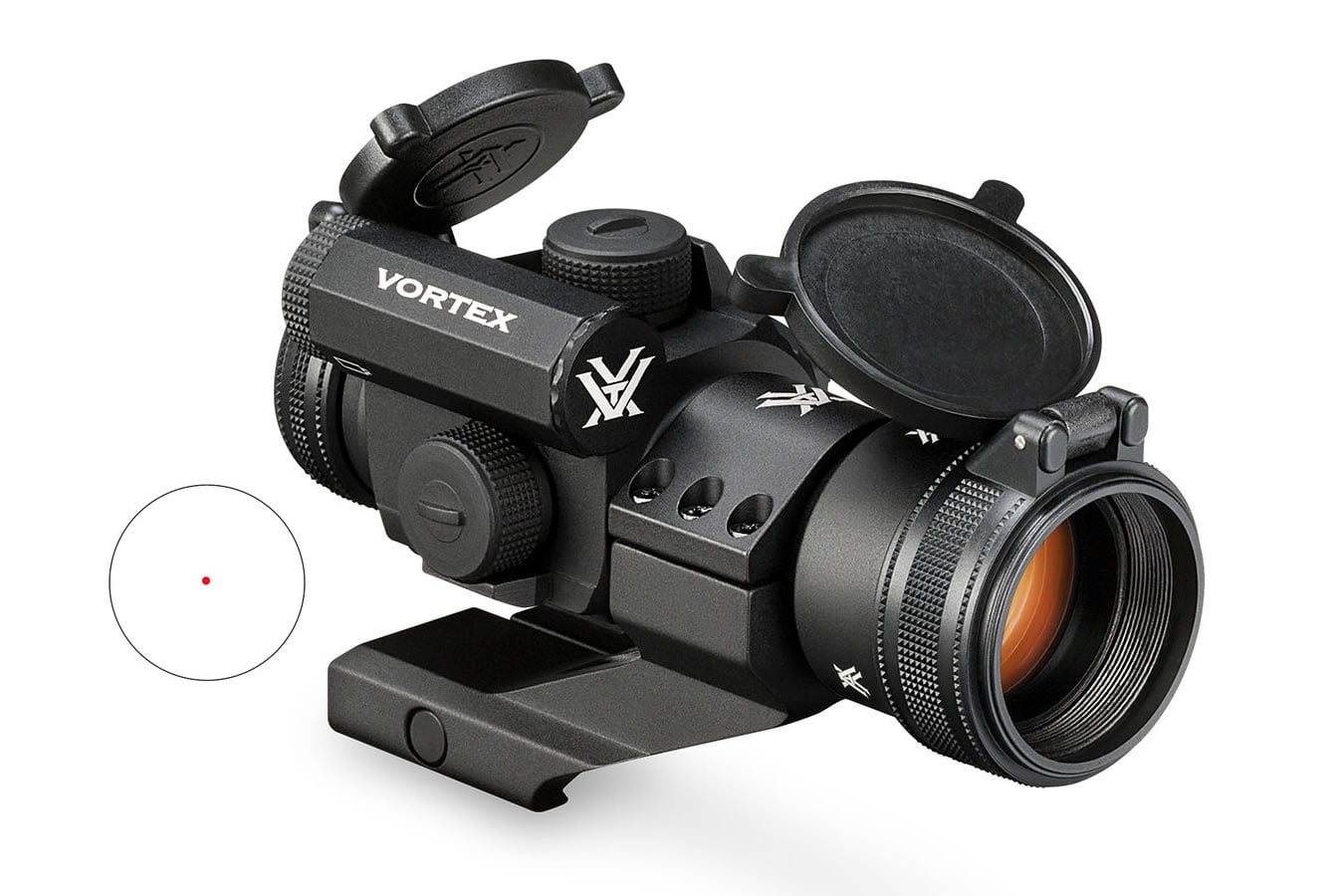
Table of Contents
Vortex StrikeFire II Specs
Dot size: 4 MOA. Dot colour: bright red, or red and green switchable model.
Magnification: 1x. Tube: 30mm, single piece aluminium alloy chassis.
Battery: one CR2. Battery life: hundreds of hours on maximum, thousands on working settings.
Auto shutoff: after 12 hours. Motion activation: none.
Brightness: 10 settings, lowest two night vision compatible. Adjustment: 1/2 MOA clicks, capped turrets.
Adjustment travel: 100 MOA elevation, 100 MOA windage. Mount included: cantilever ring mount, lower 1/3 co-witness, not quick detach.
Length: 5.6 inches. Weight: 7.2 oz, 12.8 oz with the mount.
Sealing: nitrogen purged, O-ring sealed. In the box: mount, T-15 Torx wrench, CR2 battery, flip cap covers.
Warranty: Vortex VIP, unconditional lifetime.
Vortex Strikefire 2 Problems at a Glance
No shake awake, dot off when you pick the rifle up. Every owner meets it, and it is medium to high seriousness on a defence gun.
You can manage it yourself. It costs free habits, or a newer optic.
Battery dies fast on high settings, CR2 is uncommon. This is common, and medium seriousness.
Yes, you can fix it yourself. It costs a few dollars in spares.
Zero shifts after transport or hard use. This is occasional, and medium to high seriousness.
Usually yes, you can fix it yourself. It costs free checks, mount upgrade optional.
4 MOA dot covers targets past 100 yards. This affects every unit, by design, and is low to medium seriousness.
You can work around it. A magnifier helps.
Heavy, bulky, one fixed mount height. This affects every unit, by design, and is low seriousness.
Yes, with a new mount. It costs a 30mm QD mount.
Dated controls, caps to lose, green washes out. These are common niggles, and low seriousness.
Mostly, you can fix them yourself. It costs free habits.
1. No Shake Awake: The Dot Is Off When You Pick the Rifle Up
This is the problem that defines owning a StrikeFire II in the modern era, and it comes in two flavours.
Flavour one is the 12 hour auto shutoff. The sight turns itself off after 12 hours to save the battery, which is sensible design from its period.
It also means a home defence rifle that was switched on yesterday evening is a rifle with no dot tonight. Modern sights solved this with motion activation: they sleep when still and wake in your hands.
The StrikeFire II has no motion sensor at all. Off is off until a human presses a button.
Flavour two is worse because it is silent. In a recent long term review, the tester set his carbine down during a break, picked it up fifteen minutes later, and shouldered it to a completely dark window: the brightness control had been bumped while the rifle was being set down and had clicked past the lowest setting into off, with no hard stop protecting the position.
He stood there winding the control back up while the rest of the line was already shooting. Owners of the earlier button controlled version tell the mirror story: an accidental press of the night vision button during handling makes the dot vanish in daylight just as completely.
Different controls, same lesson. This sight can go dark without telling you, and it will not wake itself up.
How to live without shake awake
- Make a dot check part of picking the rifle up. Shoulder, look, confirm the dot is there and at a usable brightness. Every time, the way you check a chamber. It takes one second and it converts this whole problem from a surprise into a routine.
- On a defensive rifle, leave it on at a moderate setting. Do not rely on switching it on under stress, and do not leave it on maximum either, because of problem two. A mid setting you have tested in your hallway at night is the right compromise, with a battery change scheduled to match.
- Put the flip caps to work. Caps closed over the lenses give the controls and the glass some protection from the bumps of racks, safes, and vehicle rides that cause half of these stories.
- Be honest about the upgrade path. If the rifle’s job is to be grabbed in the dark, a motion activated optic is the correct tool and no habit fully substitutes for it. The StrikeFire II can then retire to the range rifle, where it will be excellent for years.
2. Battery Life Depends on the Setting, and the CR2 Is an Odd Cell
Ask five sources how long a StrikeFire II battery lasts and you will get five numbers, from 300 hours to 80,000, all quoting Vortex material. Here is what is actually going on, because owners deserve the unpacked version.
Vortex’s long standing figures for the red and green model are up to 300 hours on the highest setting and about 5,000 hours on the lowest. One test review that ran the sight hard put maximum brightness endurance in the same neighbourhood, around 400 hours, and named the runtime the optic’s main weakness.
Newer listings for the bright red model claim far bigger numbers at medium settings, and an owner who has run his for eight years calls the battery life, at his settings, stupidly long and says he has changed batteries maybe twice. Both stories are true.
The variable is you: at settings you can hunt and shoot with, the battery lasts a very long time. At maximum brightness, left on, it lasts about two weeks.
Then there is the cell itself. The StrikeFire II eats a CR2, which is a camera battery that most shooters do not stock, that range shops do not always have, and that shares a drawer with nothing else in a typical gun safe.
That same eight year owner lists the CR2 as a headline con and wishes the sight used the CR123 like everything else he owns. A dead CR2 at a rural range is a sight out of action for the day.
How to manage StrikeFire II battery life
- Run the lowest brightness that does the job. Two settings lower than your instinct is usually still clearly visible, and it buys battery life in multiples, not percentages.
- Stock CR2s like you mean it. A pack in the range bag, a pack at home, one in the rifle’s storage compartment if it has one. Buying guides for this sight give the same advice with the same numbers: keep five to ten on hand.
- Change the battery on a calendar, not on a failure. Yearly for a working rifle, at the start of hunting season for a hunting rifle. A two dollar cell changed at home beats a dead dot discovered anywhere else.
- Fit it the right way round. The manual’s troubleshooting for a dead dot starts here for a reason: the battery goes in with the minus side facing outward, the cap must be snug, and the contact points clean. A backwards or loose capped battery is the most common cause of a supposedly failed StrikeFire.
3. It Lost Zero: Check the Mount Before You Blame the Sight
Search owner forums for this sight and you will find the lost zero stories, including a muzzleloader hunter who posted that his StrikeFire II lost zero and cost him during a hunt, after the rifle spent a week riding in a truck. He had checked his rings and bases and found them tight, and was left suspecting the sight or its included mount.
The most useful reply in that thread came from an experienced hand who said he sees rails and rings slip far more often than even cheap scopes actually fail, and that threadlocker and quality components ended his own run of shifting zeroes. Both halves of that exchange deserve to survive into this article, because the wider record backs them.
Other forum users have reported zero loss with the sight mounted directly to shotgun rails and been advised to use a proper mount at proper torque. And the opposite record is long: long term owners report zero holding across years and multiple rifles, and one test day put over a thousand rounds through an AR and a 12 gauge with the zero staying tight.
The fairest summary is this: the sight itself rarely loses zero. The system of rail, mount, and screws sometimes does, and a small number of genuine sight failures hide among them.
How to fix a StrikeFire II that will not hold zero
- Check the rail before the optic. A loose Picatinny rail on the receiver is the silent culprit in a share of these stories. Screws out, threads cleaned, threadlocker, torqued evenly, then witness mark everything with a paint pen so movement shows itself.
- Remount the cantilever properly. Seat it fully against a rail cross slot, push forward as you tighten so recoil works against the slot rather than walking the mount, and tighten to a firm, even torque with threadlocker on the screws.
- Confirm zero after transport. A rifle that rides in a truck for a week gets a three shot confirmation group before it gets hunted with. This is good practice with any optic and cheap insurance with a budget mount.
- Then, and only then, send it to Vortex. If the mount is proven, the rail is proven, and the zero still wanders between groups, you have one of the rare faulty units, and the VIP warranty exists for exactly this. Vortex will repair or replace it, and the turnaround stories are good.
4. The 4 MOA Dot Covers Small Targets at Distance
Four MOA is four MOA. At 100 yards the dot covers about four inches of target, at 200 yards about eight, and at 300 it covers a dinner plate.
Inside 100 yards, which is most of what this sight was built for, that big dot is a gift: fast to find, easy to track, forgiving of a rough position. Past that, on small targets, you are aiming with a sticker covering the thing you want to hit.
Detailed testing of the sight says the same thing in the same words reviewers have used for a decade: the 4 MOA dot is large for precision work beyond 100 yards, and shooters who need pinpoint hits should consider a 2 MOA optic. Owners echo it unprompted: the eight year review lists the dot size among its cons, big, covers targets at longer ranges, would prefer 2 MOA.
Nobody is describing a defect. They are describing a specification meeting the wrong job.
How to shoot a 4 MOA dot further than you would expect
- Add a 3x magnifier. This is the fix that surprises people. The dot is still 4 MOA, but the target triples in size behind it, so the dot covers proportionally less of what you are aiming at, and your hold becomes precise. The cantilever mount already positions the sight where a magnifier wants to sit behind it.
- Aim with the top edge of the dot. For a small target at distance, put the dot’s upper edge where you want the bullet, not the centre. It is the oldest red dot trick there is and it effectively halves your aiming blob.
- Zero at a sensible distance. A 50 yard zero on a carbine keeps you honest inside the distances this sight is for, and keeps your holds simple. Zeroing at 25 yards to shoot at 200 is how a 4 MOA dot gets blamed for a trajectory problem.
- Know the exit. If your rifle exists to shoot small things past 150 yards, sell this sight to the carbine shooter it belongs to and buy a 2 MOA dot. That is not failure. That is matching tools to jobs.
5. It Is Heavy, It Is Long, and the Mount Is Fixed

The numbers in one breath: 7.2 ounces of optic, 5.6 inches of length, and 12.8 ounces total once the included cantilever mount is on. On a carbine, that is noticeable weight parked at the front half of the gun, and reviewers say so in their cons lists in almost the same words: adds noticeable front weight.
Comparable micro dots weigh half as much mounted, which is the entire reason the micro category exists.
The mount itself draws the rest of the complaint. It is a solid bolt on cantilever that gives one height, lower 1/3 co-witness, and that is your lot.
It is not quick detach, so the sight does not pop off for iron sight practice or move gracefully between rifles, and owners who prefer absolute co-witness or a different height are shopping for a replacement on day one. One eight year owner mentions discarding the cantilever immediately for his own setup, which is a common story.
How to fix the StrikeFire II’s weight and mount limits
- Use the tube. The one genuine advantage of a 30mm tube sight is that the mount world is yours. Any quality 30mm ring or mount fits, including quick detach mounts that return to zero well enough for a 4 MOA dot’s purposes, and lower mounts for non AR hosts like shotguns and pistol calibre carbines.
- Mount it as far forward as your rail sensibly allows. The cantilever exists to push the sight forward, clear of magnifiers and rear sights, and to balance the gun better than a mid rail position does. Use the design as intended before replacing it.
- Weigh the whole build, not the optic. On a hunting rifle the StrikeFire’s weight is a shrug. On a lightweight build where every ounce was argued over, a 12.8 ounce optic and mount undoes expensive decisions, and a micro dot is the right call from the start.
6. Dated Controls, Caps to Lose, and a Green Dot That Washes Out
A handful of smaller complaints travel together because they all date the design.
The turrets adjust in half MOA clicks, which is good, under caps, which is normal, and the caps are loose parts the moment you unscrew them at the range, while the adjustment slots underneath want a coin or a flathead rather than your fingers. A current review lists it plainly among the cons: turret adjustments require a coin or flathead, slowing the zeroing process.
Zeroing this sight is a small ceremony of misplaced caps and borrowed coins compared with a modern finger turret optic.
The rear controls and their detents are the other half, covered for their worst consequence in problem one. And the red and green model carries one more quirk: the green dot washes out in bright conditions sooner than the red, which at least two review cons lists name directly.
Green looks brighter to the eye in shade and fools a lot of buyers. In full sun against a bright background, red at full power wins, and full power is where problem two’s battery drain lives, which is why experienced owners recommend the red only model.
How to smooth out the StrikeFire II’s rough edges
- Give the turret caps a home. The same pocket of the range bag, every time, the second they come off. Caps lost at public ranges are a tax on the unorganised, and replacement furniture is a boring way to spend money.
- Carry a coin sized multi tool in the range kit. The T-15 wrench comes in the box for the mount. The turrets want a flathead. One small tool that does both lives in the bag and zeroing stops being a ceremony.
- Buy red, or run red. If you are choosing between models, choose the bright red version. If you own the red and green, save green for shade, woods, and low light, and switch to red before the sun gets high.
- Set brightness for the target, not the sky. A dot that looks perfect against the berm washes against a pale hillside. Check it on the brightest background you will shoot against and set it there.
Vortex Strikefire 2 Problems That Are Not Really Faults
The dot turned itself off overnight. That is the 12 hour auto shutoff, working exactly as designed, and it surprises every new owner once.
It is covered as problem one because of what it means for a defence gun, but on any other gun it is a battery saving feature, not a malfunction.
The glass is not as clear as a premium optic. One thorough review noted the light transmission could be a little better, and that is the honest ceiling of a budget tube sight with fully multi coated glass.
It is entirely usable glass. It is not a flagship window, and it was never sold at a flagship price.
The flip caps feel cheap. They do, on every optic that ships with them at this price, and they still keep rain, dust, and safe rash off the lenses for years.
Judge them as covers, not as jewellery.
Vortex StrikeFire II Maintenance Checklist
- Dot check every time you pick the rifle up, no exceptions
- Change the CR2 yearly on a working gun, and keep spares in the bag
- Fit the battery minus side outward, cap snug, contacts clean
- Witness mark the mount screws and check them after transport
- Confirm zero with three shots after any long vehicle ride
- Turret caps go in the same bag pocket every time they come off
- Run the lowest brightness that does the job, and recheck it on bright backgrounds
- Wipe lenses with a proper cloth after blowing dust off first
Is the Vortex StrikeFire II Still Worth Buying?
Yes, for the jobs it was designed for, and the market has kept it alive this long because those jobs are common.
Read the problem list back with fresh eyes. Nothing on it is about the sight failing to shoot straight or falling apart.
It is about the sight being from an era before motion sensors, micro housings, and finger turrets, and asking its owner to supply the habits those features replaced. Owners who supply them, and there are eight year reviews in this article’s sources to prove the type, get a big clear window, a dot that holds zero, and a warranty that covers the whole optic for life, electronics included, which no close competitor at this price matches.
Buy it for a range carbine, a hunting rifle inside 150 yards, a shotgun, or a spare parts bin build that needs a real optic. Think harder if the rifle is a bedside gun, where problem one lives, or a lightweight build, where problem five lives.
That is not damning a good sight. That is placing it where it wins.
Conclusion
Vortex Strikefire 2 problems are what happens when a good design gets old in public.
The industry moved. Sights learned to wake themselves, shrank to half the weight, grew brighter on a smaller battery, and put their adjustments under your fingers.
The StrikeFire II did none of that, because it did not need to in order to keep doing its actual job, which is putting a durable dot on a rifle for modest money and holding it there under a lifetime warranty. Judged as a 2026 features list, it is dated.
Judged as an optic that owners run for eight years across multiple rifles in Gulf Coast heat and subzero cold, it is a success with quirks.
Supply the habits it asks for. Check the dot, feed it CR2s on a schedule, torque the mount and mark the screws, and keep it inside the distances a 4 MOA dot serves.
Do that, and this big simple sight will probably outlast the rifle you mounted it on.
Sources used for this article: the Vortex StrikeFire II product manual, long term and updated reviews from ScopesReviews, TheGunZone, Red Dot Sight Reviews, High Ground Media and Revell Photography, a Rokslide owner thread on lost zero, AR15.com owner reviews, Adorama long term owner reviews, and Vortex retailer specification listings. Last updated: October 2026.
FREQUENTLY ASKED QUESTIONS
It is the 12 hour automatic shutoff, a battery saving feature. The sight also goes dark if the brightness control is bumped past its lowest setting, which racks and benches do more often than owners expect, because there is no hard stop protecting the off position. The sight has no motion activation, so it never turns itself back on. Build a dot check into picking the rifle up.
It depends on brightness more than anything else. Vortex’s figures for the red and green model are up to about 300 hours on the highest setting and roughly 5,000 hours on the lowest, and newer listings quote far higher numbers at medium settings. At sensible working brightness owners report years from a CR2. Left on maximum, expect about two weeks. Keep spare CR2s, it is not a common cell.
In most owners’ experience, yes, including long term owners who have run one across several rifles and testers who ran a thousand rounds in a day. The reported zero losses usually trace to the mount or the rail rather than the optic. Torque the cantilever mount with threadlocker, witness mark the screws, confirm zero after transport, and if a proven mount still shifts, the VIP warranty covers the sight.
For the sight’s intended work, yes. It covers about 4 inches at 100 yards, which is fine for carbines, defensive shooting, and deer sized targets at woods ranges. It is the wrong tool for small targets past 150 yards. A 3x magnifier improves practical precision a lot, and aiming with the top edge of the dot helps at distance. For mostly long range shooting, buy a 2 MOA optic instead.
They are the two default budget answers and they split on one feature. The Romeo5 has MOTAC motion activation, is much lighter, and runs on a common AAA battery. The StrikeFire II has a bigger 30mm window, a coarser 4 MOA dot, and the Vortex VIP lifetime warranty covering everything including electronics. For a home defence rifle the motion activation is a serious argument. For a range or hunting rifle, the Vortex warranty and window argue back.
Work through the manual’s checklist. Is the battery dead. Is it fitted correctly, with the minus side facing outward. Is the battery cap snug and are the contact points clean. Then check you have not simply run into the 12 hour shutoff or a bumped brightness control. A sight that fails all of those checks on a fresh battery is a warranty return, and Vortex makes those painless.
Yes, the build handles shotgun recoil and owners use it on turkey and defensive shotguns happily. Two cautions from owner reports: mount it on a proper rail with a quality mount at correct torque rather than trusting marginal rails, since shotgun recoil finds loose mounts quickly, and confirm your zero after the first box of full power loads.